

Research into beets’ performance-boosting potential goes back a decade [1, 8]. From effects on cardiovascular disease [15] to repeated-sprint performance [14], our knowledge of how beet juice impacts the body has continued to grow.
In this guide, I’ll explain:
- How beet juice works
- How much you need to consume to get a performance benefit
- When you should consume it
- Practical considerations for maximizing the effectiveness
Let’s get started.
1: How It Works
Like other dark leafy greens [3], the special sauce in beets is nitrate (NO3–) [1]. After drinking beet juice, nitrate gets converted to nitrite (NO2–), which is then stored and circulated in the blood as nitric oxide (NO) [1, 4, 5]. NO helps to improve exercise economy and efficiency while reducing fatigue [4].

While many studies support the idea that beet juice can improve cycling performance, other studies provide evidence to the contrary [2]. Why the discrepancy?
In short, most studies follow slightly different protocols, give participants varying amounts of nitrate, and have differing participant characteristics. These variables don’t always lead to statistically significant results. If a finding doesn’t reach statistical significance, it’s not worth our time, right? Not exactly.
In sports performance, meaningful improvements often fall short of the standard of statistical significance [2]. For example, if you win a time trial by 1 second, that second might be under the standard of statistical significance while still making the difference between winning and losing.
For this reason, enough meaningful evidence exists to suggest that supplementing with beet juice can make you faster on the bike, provided you follow a few important guidelines [2].
The first guideline is tied to how much nitrate it takes to boost performance.
Ride Basic: A Minimalist Guide to Maximize Your Cycling
Whether you’re a beginner eager to complete your first fondo, or a seasoned pro aiming to refresh the foundational principles of long-term cycling success, this time-efficient guide offers invaluable insights into why and how you can Ride Basic.

2: How Much to Consume
Current science recommends consuming beet juice containing ≈6-12 mmol (≈400-800mg of nitrate) [4, 17 ]. Research suggests that high-performance athletes might need to be near the top end of this range to see benefits [6, 17].
In a practical sense, that’s a lot of nitrate. Your nitrate doesn’t have to come from beet juice to be effective; spinach and arugula are two other valid options [7], but for most people, beet juice is the most convenient and palatable.
So, how do you know if your beet product contains anywhere near the 6 mmol of nitrate required to boost performance?
Simply put, it’s difficult to ensure the quality of different beet products. Different beets or beet juice products contain a wide range of nitrate [3, 16]. To better understand this variability in nitrate content, researchers examined 24 of the most popular beet juice products on the market.
Unsurprisingly, most products fell below the 6 mmol threshold (this study highlights a 5 mmol threshold) [16]. Data from this research can be seen in the graphic below.
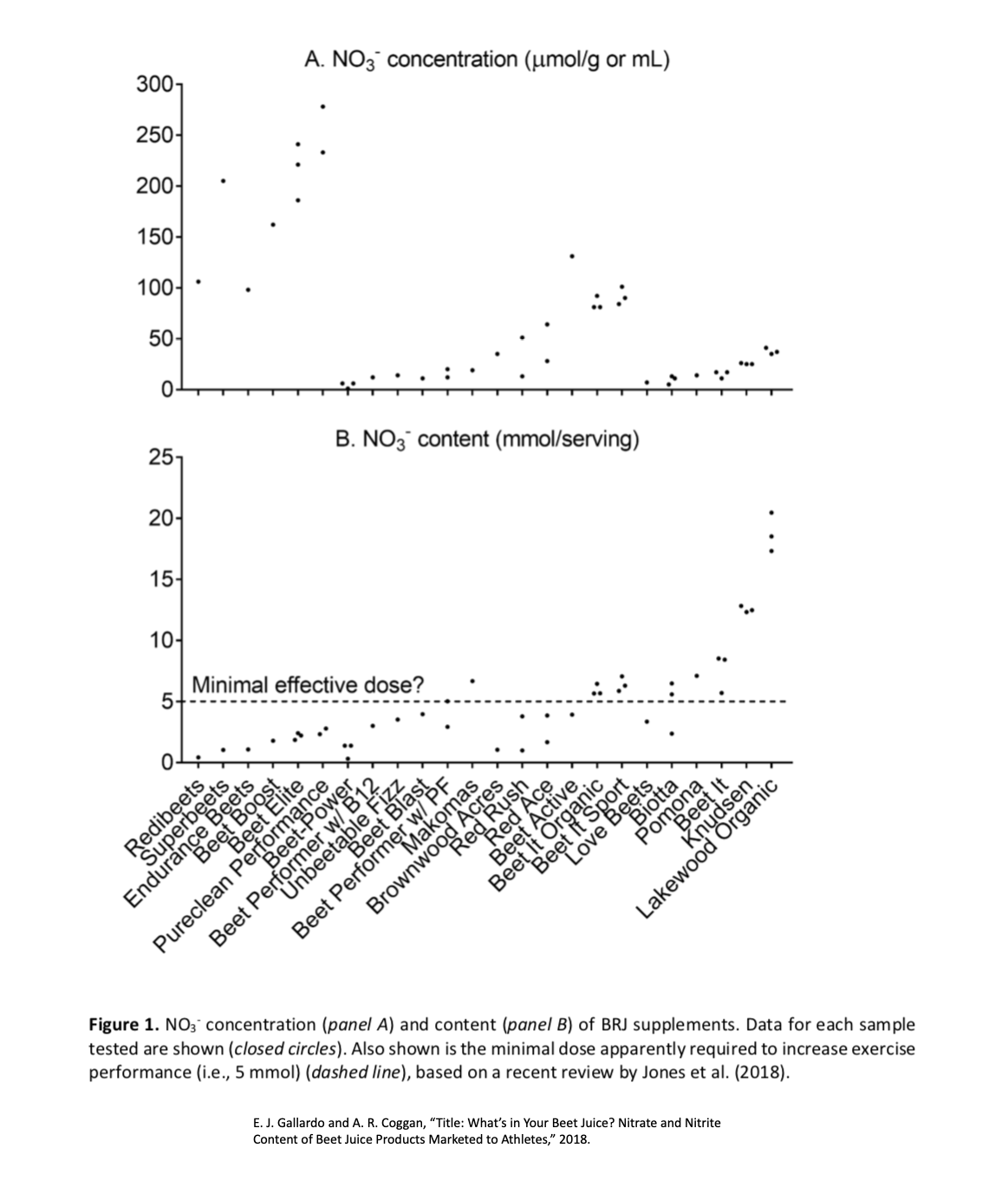
In a practical sense, you can’t know how much nitrate a product contains unless its nitrate content is listed on the label. In simple terms, buy a product with nitrate content displayed on the label.

Personal Cycling Coaching
From scattered effort to structured progress—real results through human cycling coaching

3: When You Should Consume It
Peak nitrate concentration is obtained about 2-3 hours after consumption, so hitting your beet juice at least 1 ½ hours before your ride/race (acute supplementation) makes the most sense [4, 8].
Suppose you want to double down on your chance of beet juice success. In that case, evidence suggests that supplementing for about 6 days prior (chronic supplementation) to your key event and the hours before might give you the best chance for a performance boost [9, 10].
In summary, if you’re trying to save money, experiment with one dose at least 1 1/2 hours before your event. If you’ve got cash to burn, consume a daily dose the week before.
Roadblocks
Before you go off chugging beat juice, there are a few important caveats to mention:
- Mouthwash seems to kill important bacteria utilized in the digestion/conversion of nitrate to nitric oxide [11]. In short, don’t get mouthwash anywhere near your expensive beet juice.
- If you supplement with caffeine before races, beet juice seems to offer no additive benefit and might impede the performance-enhancing properties of caffeine [12]. In other words, if caffeine is a regular part of your pre-race routine, and you’re committed to trying both, experiment with chronic beet juice supplementation (one dose daily in the week prior), then use your caffeine blast on race day [18].
- Recent research suggests that other vegetables (specifically kale, cabbage, sprouts, and broccoli) might counteract beet juice’s positive effect [13]. Consuming these vegetables at different times than your beet juice might make sense just to make sure.
4: Practical Recommendations
We’ve covered a lot of ground with beet research; let’s break it down to the bare essentials:
- Even though beet juice research contains conflicting results, there is strong enough evidence to recommend beet juice supplementation as a dietary supplement for improving cycling performance.
- To be effective, your beet juice must contain a minimum of ≈6mmol (≈400mg) of nitrate. If you don’t know the nitrate value of your product, you might be wasting your money.
- Concentrated beet juice shots are the most practical form of nitrate for most cyclists. One shot contains 6.45 mmol of nitrate (around the minimum dose recommended), and two shots get you toward the maximum range of 12 mmol recommended for elite athletes.
- For acute supplementation, drink 1-2 shots of concentrated beet juice about 1 ½ hours before your event.
- If you’re an elite athlete chasing small performance margins, going over 8mmol (1 1/4+ shots) of nitrate might be necessary for each dosage.
- Supplementing for 6 days before your event might enhance the effectiveness of beet juice.
- Don’t get mouthwash near your beet juice.
- It might make sense to avoid kale, cabbage, sprouts, and broccoli in meals you’re also supplementing with beet juice.
- If you’re already getting jacked on caffeine before races but still want the benefit of beet juice, make sure to supplement chronically (once daily in the week before your event)
References
- Larsen, F.J., et al., Effects of dietary nitrate on oxygen cost during exercise. Acta Physiol (Oxf), 2007. 191(1): p. 59-66.
- McMahon, N.F., M.D. Leveritt, and T.G. Pavey, The Effect of Dietary Nitrate Supplementation on Endurance Exercise Performance in Healthy Adults: A Systematic Review and Meta-Analysis. Sports Med, 2017. 47(4): p. 735-756.
- Lidder, S. and A.J. Webb, Vascular effects of dietary nitrate (as found in green leafy vegetables and beetroot) via the nitrate-nitrite-nitric oxide pathway. Br J Clin Pharmacol, 2013. 75(3): p. 677-96.
- Dominguez, R., et al., Effects of Beetroot Juice Supplementation on Cardiorespiratory Endurance in Athletes. A Systematic Review. Nutrients, 2017. 9(1).
- Jones, A.M., Dietary nitrate supplementation and exercise performance. Sports Med, 2014. 44 Suppl 1: p. S35-45.
- Peeling, P., et al., Beetroot Juice Improves On-Water 500 M Time-Trial Performance, and Laboratory-Based Paddling Economy in National and International-Level Kayak Athletes. Int J Sport Nutr Exerc Metab, 2015. 25(3): p. 278-84.
- Jonvik, K.L., et al., Nitrate-Rich Vegetables Increase Plasma Nitrate and Nitrite Concentrations and Lower Blood Pressure in Healthy Adults. J Nutr, 2016. 146(5): p. 986-93.
- Webb, A.J., et al., Acute blood pressure lowering, vasoprotective, and antiplatelet properties of dietary nitrate via bioconversion to nitrite. Hypertension, 2008. 51(3): p. 784-90.
- Thompson, K.G., et al., Influence of dietary nitrate supplementation on physiological and cognitive responses to incremental cycle exercise. Respir Physiol Neurobiol, 2014. 193: p. 11-20.
- Kelly, J., et al., Effects of nitrate on the power-duration relationship for severe-intensity exercise. Med Sci Sports Exerc, 2013. 45(9): p. 1798-806.
- Govoni, M., et al., The increase in plasma nitrite after a dietary nitrate load is markedly attenuated by an antibacterial mouthwash. Nitric Oxide, 2008. 19(4): p. 333-7.
- Glaister, M., et al., Effects of Dietary Nitrate, Caffeine, and Their Combination on 20-km Cycling Time Trial Performance. The Journal of Strength & Conditioning Research, 2015. 29(1): p. 165-174.
- Dewhurst-Trigg, R., et al., Lowering of blood pressure after nitrate-rich vegetable consumption is abolished with the co-ingestion of thiocyanate-rich vegetables in healthy normotensive males. Nitric Oxide, 2018. 74: p. 39-46.
- Jonvik, K.L., et al., Repeated-sprint performance and plasma responses following beetroot juice supplementation do not differ between recreational, competitive and elite sprint athletes. Eur J Sport Sci, 2018: p. 1-10.
- Woessner, M.N., et al., Dietary Nitrate supplementation in Cardiovascular Health: An ergogenic aid or exercise therapeutic? Am J Physiol Heart Circ Physiol, 2017: p. ajpheart 00414 2017.
- E. J. Gallardo and A. R. Coggan, “Title: What’s in Your Beet Juice? Nitrate and Nitrite Content of Beet Juice Products Marketed to Athletes,” 2018.
- Lorenzo Calvo, J., et al. (2020). “Influence of Nitrate Supplementation on Endurance Cyclic Sports Performance: A Systematic Review.” Nutrients 12(6).
- Ferrada-Contreras, E., et al. (2023). “Does Co-Supplementation with Beetroot Juice and Other Nutritional Supplements Positively Impact Sports Performance?: A Systematic Review.” Nutrients 15(22).